Showing posts with label Routing. Show all posts

Wednesday, 30 March 2016

Migration Methods

In this post, we will discuss various options to migrate customer's network from one service provider to other service provider. 

Let's assume that you work for an enterprise customer with three sites. All the sites are currently connected through a Layer 3 IPVPN solution provided by service provider A.


Sunday, 17 January 2016

BGP PIC EDGE

Continuing from our previous post, we will now see how BGP PIC EDGE works. We will use the same topology. The only difference is that I have removed R4 as route-reflector. All the PEs have full mesh IBGP neighbourship. 

At the moment R2 learns 8.8.8.8/32 from R6 and R7. It prefers the path with the next-hop of 6.6.6.6 over 7.7.7.7.

Friday, 1 January 2016

BGP PIC CORE

Happy New Year Folks!

In one of the previous posts, we looked at EIGRP FRR and OSPF LFA feature which helps achieving fast convergence.

There is a similar feature  in BGP which is called PIC (Prefix Independent Convergence). It speeds up the convergence of the FIB in failover conditions. BGP works differently than any IGP. It is designed to carry hundreds of thousands routes in the routing table hence fast failover works differently in BGP. There are couple of ways to implement PIC in BGP. They are "PIC Core" and "PIC Edge". We will look into both of these options.

Let's look at the below topology.

Saturday, 31 October 2015

EIGRP IP FRR & OSPF LFA

In today's modern networks, fast convergence has become a mandatory requirement.
If we want to achieve fast convergence, each of the steps below need to be optimized

1. Failure Detection
2. Failure Propagation
3. Processing of new information
4. Updating RIB/FIB

1. Failure Detection:- "How long does it take me to detect a failure?"
This normally depends on the Hello/Hold down/Dead timers of the routing protocol. We can either tune these timers or use a mechanism such as "BFD" which we have seen in our earlier post.

2. Failure Propagation:- "How long does it take me to tell everyone else?"
In EIGRP, this is done through Query/Reply packets. We can reduce the Query domain by configuring the routers as "stub".

In OSPF, this depends on the area size and the LSA flooding procedure. We can tune the LSA timers to change this.

Friday, 10 July 2015

IPv6 tunneling over IPv4 - 6to4 Autotunnel

In the previous post, we looked at the IPv6 tunneling technique using IPv4 manual tunnels. We will now see how dynamic multipoint IPv6 tunnel works.

6to4 tunnels allow for the dynamic creation of IPv6 within IPv4 tunnels. Manual tunnel is normally used as point-to-point however 6to4 tunnels can be point-to-multipoint.

The 2002::/16 range has been reserved to use for tunneling. We will have to add the IPv4 address into this range to generate /48 prefix. i.e. if the IPv4 address of the border router is 192.168.1.1 then the 6to4 site address prefix becomes 2002:C0A8:101::/48 (Convert 192.168.1.1 to Hex which results in C0A8:0101)

We will work on the same topology we used in the previous post.


Tuesday, 30 June 2015

IPv6 tunneling over IPv4 - Manual Tunnel

We know that IPv4 and IPv6 addresses are not compatible with each other. Let's say the existing infrastructure is running on IPv4. If we need to implement IPv6 on few of the hosts, we need to use some sort of a technique for IPv6 hosts to communicate with each other using existing IPv4 network. One of the ways we can achieve this is by using a tunneling method.

In this post we will see how we can implement "Manual Tunnel". 

As shown in the diagram below, we have R1, R2 and R3 connected with each other. 


All three routers are running EIGRP and there is an IPv4 reachability from R1 to R3.

Thursday, 18 June 2015

BFD (Bidirectional Forwarding Detection)

In this post, we will look into a feature called BFD (bidirectional forwarding detection). In normal routing protocol operation, the link failure is detected by using the hello/holddown/dead timers. 

Depending on the routing protocol, you can lower the timers to achieve fast failure detection. e.g. in the case of OSPF the lowest dead time can be one second and one can set the hello interval as low as 50ms.

However lowering these timers can result in higher CPU utilization. Also it will unnecessarily waste the link bandwidth. 

There is a better way of achieving fast failure detection through BFD. BFD is a UDP-based protocol that provides fast (in milliseconds) routing protocol independent detection of layer-3 next hop failures.

Let's see how it works. As shown in the diagram below, routers R1 and R2 are connected via Switch 1 and Switch 2. Both the routers are running OSPF and we can see the OSPF neighbourship is up.


Wednesday, 1 April 2015

6VPE

6VPE (IPv6 VPN Provider Edge Router) is a feature which connects the customer sites configured with IPv6 addressing over the existing IPv4 MPLS backbone.

In our last post, we have seen how we can configure standard Layer 3 MPLS connection on Cisco routers and advertise customer's IPv4 prefixes over that. 

We will use the same topology for 6VPE however we will configure IPv6 addresses between PE to CE (R1-R2 and R5-R6) and on the Loopbacks of the CEs (R1 and R6).

This is how our topology looks like


Wednesday, 18 March 2015

Layer 3 MPLS VPN

In this post we will look at the steps of configuring Layer 3 MPLS VPN on Cisco routers.

As shown in the diagram, R1 and R6 are CE routers. R2 and R5 are PEs while R3 and R4 are P routers.


Wednesday, 29 October 2014

FIND EIGRP Neighbour K Values

In the last post we have seen how we can find the EIGRP neighbour AS number without looking at the router config. We can also find out the remote router's K values in a similar way.

To demonstrate this I will use the existing topology and change the K values on R1. We know that the default K values are K1=K3=1 and K2=K4=K5=0
I will change the values on R1 to K1=K2=K5=1 and K3=K4=0


Monday, 27 October 2014

Find EIGRP Neighbour AS Number

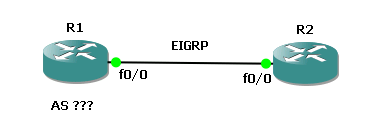
Today we will see how we can find the EIGRP Neighbour AS number without looking at the config of the remote router.

In the topology, I have R1 which is directly connected to R2.

Let's assume that R1 is the third party router which is configured for EIGRP. R2 is in our control and we need to establish EIGRP neighbourship between them.

Both the routers have been configured with basic IP addresses as below

Friday, 26 September 2014

Load Sharing via Secondary Link - Part 2

Let's look at the routing behaviour from the reverse direction now i.e.R5 to R1

Traceroute shows


We can see that even if the outbound path from R1 for the destination 2.2.2.2 was R1-R2-R3-R4-R5, the return path is R5-R4-R2-R1 which means that it prefers the primary CPE for inbound routing. We have an asymmetric routing issue.

Monday, 22 September 2014

Load Sharing via Secondary Link - Part 1

If you are working for a service provider then you may have seen that it is quite  a common practice to install two circuits and two CPEs at a customer site for the resiliency purpose. One of these circuits act as primary and carry all the inbound/outbound traffic. The second circuit acts as a backup and not used unless the primary circuit or the CPE fails.

Here is the diagram showing the scenario


On customer Site A, we have two CPEs, R2 as the primary and R3 as the backup. R1 represents a customer device on the LAN.  This customer has another remote office Site B which is shown as R5 (Single CPE). R4 is the service provider router.